
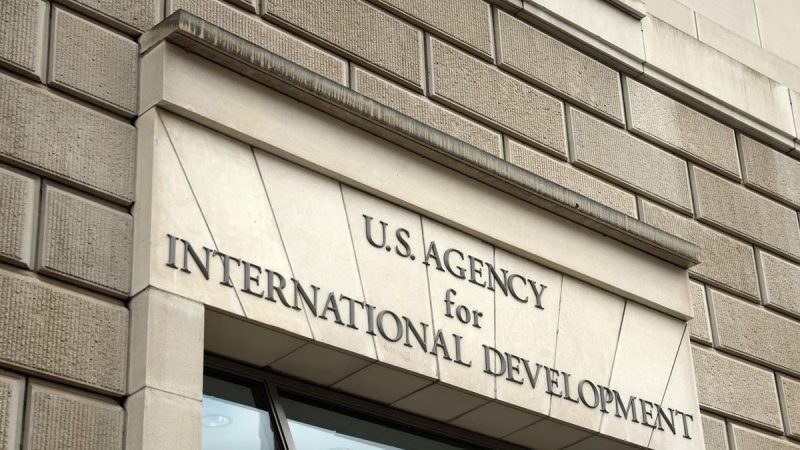
For months after the Trump administration dismantled the U.S. Agency for International Development, critics warned that America’s global health programs were being gutted. What drew far less attention was what replaced it.
In December 2025, the White House quietly rolled out the America First Global Health Strategy, shifting control of U.S. global health aid from USAID to the State Department and fundamentally rewriting how billions of dollars in foreign assistance are distributed.
The transition has been shaped in part by a small group of former officials now advising the White House from the private sector, including former USAID administrator Mark Green and former lawmakers Ted Yoho and Chris Stewart. They are not running the programs, but they have been involved in pressing for clearer accountability standards, tighter performance metrics and congressional guardrails they say are necessary if the new framework is going to last beyond a single administration.
At the core of the strategy is a sharp break from how U.S. health aid traditionally has worked. The America First Global Health Strategy replaces USAID’s grant-heavy, nongovernmental organization-driven model with country-by-country agreements that tie funding to performance benchmarks and push foreign governments to assume greater responsibility over time. The framework promises tighter control over spending, but many of its enforcement details — including how benchmarks will be set and applied — are still being developed.
So far, the strategy has been implemented through a limited number of bilateral health agreements negotiated country by country. In December 2025, the United States signed a five-year health cooperation agreement with Kenya, covering areas such as HIV/AIDS, malaria and tuberculosis, with U.S. funding tied to continued performance and increased co-investment by the Kenyan government. Similar memorandums of understanding have since been signed or are under negotiation with countries including Nigeria and Cameroon, according to State Department disclosures.
Congress has long appropriated global health funding at a high level, giving USAID broad discretion over how programs were designed and implemented — a structure that left lawmakers with oversight but little involvement in individual funding decisions. Yoho said that discretion allowed the agency to drift over time.
‘It lost the purity of purpose of what it was designed to do,’ Yoho said. ‘They lost their mark and they became political and ideological.’
The new strategy, by contrast, explicitly frames global health assistance around U.S. national security, bilateral relationships and economic interests. But because it has not been codified into law, those priorities could be redefined or reversed by a future administration.
‘If it’s not codified in the law, how aid is supposed to be done, it’ll go away if we flip to a Democratic administration,’ Yoho said.
Former Rep. Chris Stewart, who served on both the House Intelligence Committee and the Appropriations subcommittee responsible for funding foreign assistance, said that even lawmakers who approved global health spending often had limited visibility into how programs operated once money left Washington.
‘Even as an appropriator — someone who supposedly wrote the checks — we didn’t have the oversight that we needed,’ Stewart said.
Under the America First Global Health Strategy, Stewart said oversight is intended to begin earlier, with clearer priorities and closer alignment between U.S. objectives and what recipient countries actually want. During his travels, Stewart said foreign leaders repeatedly told him they were less interested in open-ended aid than in building their own capacity.
‘We don’t really just want aid,’ Stewart said. ‘We want trade. We want to build our own capacity.’
Stewart said the shift toward government-to-government agreements is intended to make spending more traceable and more directly attributable to the United States, while still requiring firm controls to prevent waste or abuse.
‘That doesn’t mean every government we work with is perfect,’ he said, ‘but it does make it easier to know where the money is actually going.’
Supporters of the new framework point to longstanding disease-specific programs as evidence that tighter oversight does not require abandoning global health investments altogether. Yoho, Stewart and Green all cited PEPFAR, the U.S. government’s HIV/AIDS initiative, as a model of bipartisan foreign assistance that has saved lives while strengthening U.S. relationships abroad.
Stewart and Green also pointed to malaria prevention efforts, while both emphasized child health and nutrition as areas Congress should continue to prioritize.
Yoho also cited the use of ready-to-use therapeutic food (RUTF) to treat severe childhood malnutrition, describing it as a low-cost intervention with clear humanitarian impact and broad bipartisan support.
Former USAID administrator Green said the strategy is built around accelerating what he calls the ‘journey to self-reliance,’ moving countries from long-term aid recipients to partners — and eventually, in some cases, donors themselves.
‘We want every country to go from being an aid recipient, to a partner, to — in a perfect world — a fellow donor and investor,’ Green said.
Under the new framework, Green said global health assistance is negotiated nation by nation through bilateral agreements tailored to local conditions and reciprocal obligations.
‘This isn’t a handout,’ he said. ‘This instead is a joint venture between the U.S. and the government in another country,’ designed to build local capacity and shift responsibility over time.
The strategy also places greater emphasis on leveraging private-sector tools alongside government funding.
Green pointed to partnerships with U.S. companies such as Zipline, which uses drone technology to deliver blood and medical supplies in hard-to-reach areas, as an illustration of how the framework seeks to pair public health goals with American innovation.
Still, Green acknowledged that much of the system remains a work in progress. While the agreements are intended to tie funding to performance and burden-sharing, he said many of the specific benchmarks and enforcement mechanisms are still being finalized.
‘A wedding is easy and a marriage is hard,’ Green said, describing the challenge of translating broad agreements into measurable, enforceable outcomes.
For supporters of the new strategy, the tighter focus on accountability is also meant to address longstanding skepticism on the right about foreign aid itself. Yoho said he once shared that skepticism.
‘I was one of those that wanted to get rid of foreign aid,’ he said. ‘Then I got up there and realized how ignorant I was about good, effective foreign aid.’
He said the argument becomes easier when programs are clearly defined and measurable.
‘If representatives have credible information and can go back to their constituents and explain why we should support something — because it makes America safer, stronger, and more prosperous — the majority of people will support it,’ Yoho said.
Whether the America First Global Health Strategy ultimately delivers on its promises — or exposes new risks — may depend less on its design than on how much authority Congress chooses to formalize, and how rigorously the administration enforces the accountability standards it has laid out.
